
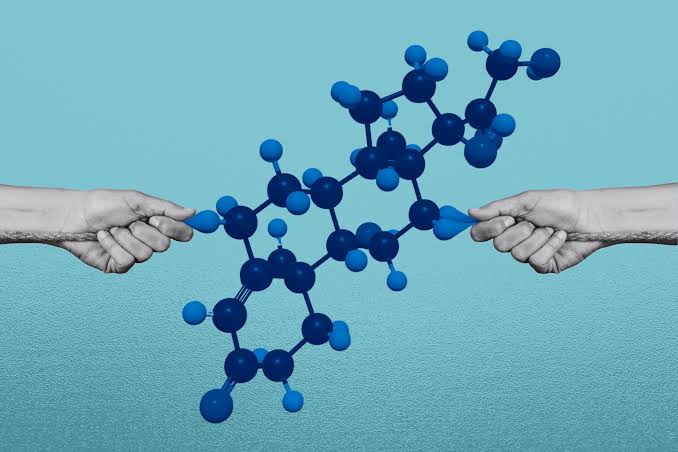
Before your feet even touch the floor in the morning, the transition has begun. It starts with a blue-lit screen glowing in the dark. A single glance at a flagged email, a chaotic news headline, or a calendar packed with back-to-back commitments, and a silent cascade of chemistry floods your system. Your heart rate ticks upward by a few beats. Your breath becomes slightly shallower. You are awake, but more than that, you are prepared for battle.
This is the modern alarm system in action. It is incredibly efficient, designed by millions of years of evolution to keep us alive. But in our quest to manage demanding careers, families, and the relentless velocity of 21st-century life, we have turned a temporary survival mechanism into a permanent lifestyle.
We are living in a state of chronic, low-grade alertness. And our biology is paying a quiet, compounding tax for it.
How Our Stress Response Got Stuck

To understand why we feel so profoundly depleted by the end of the week, we have to look at the elegant design of our autonomic nervous system. Our bodies are governed by a simple, rhythmic pendulum. On one side is the sympathetic state—the “fight-or-flight” response that mobilizes resources to meet a crisis. On the other is the parasympathetic state, the “rest-and-digest” mode where the body repairs tissues, balances hormones, and digests food.
Our ancestors used the sympathetic system sparingly. A predator appeared; cortisol and adrenaline spiked; the human ran, fought, or hid. Once the threat was resolved, the pendulum swung back into deep, restorative recovery.
Today, the predator is your inbox. It is the traffic on the commute, the looming project deadline, and the constant, vibrating ping of notifications in your pocket. Because these micro-stressors never truly disappear, the pendulum is stuck. You are not running from a threat, but biochemically, your body acts as if you are permanently standing on the savanna, scanning the horizon for danger.
The Connection Between Stress and Inflammation
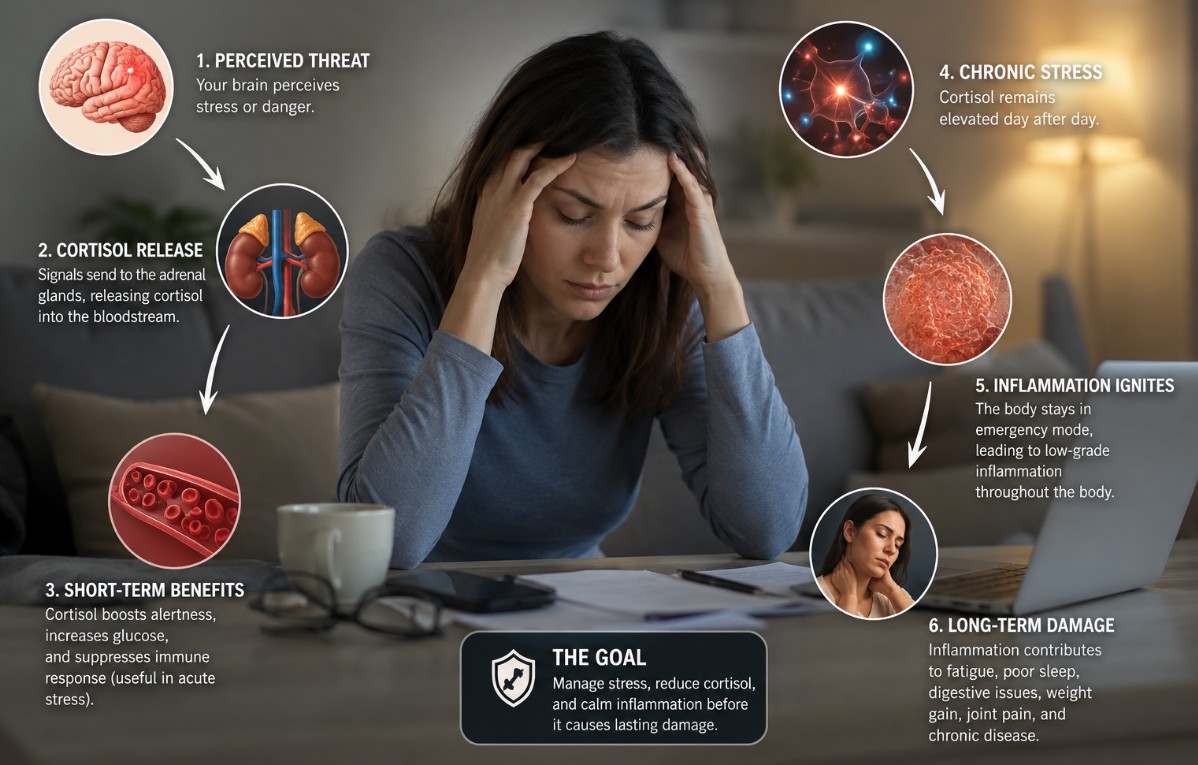
When the brain perceives a threat, it signals the adrenal glands to release cortisol. In short, acute bursts, cortisol is a biological miracle. It sharpens focus, temporarily suppresses the immune response so energy can be diverted to our limbs, and mobilizes glucose to feed our muscles. It is designed to save your life.
But when cortisol remains elevated day after day, it becomes systemic rust.
Because your body believes it is in a perpetual state of emergency, it deprioritizes long-term maintenance. It reduces the quality of your deep sleep, compromises the integrity of your digestive tract, and alters how you store fat. Your brain is essentially running emergency software, and in emergency mode, there is no time to perform routine cellular repairs.
When cortisol remains chronically elevated, our tissues eventually become desensitized to its signals. This cellular deafness allows a silent, low-grade inflammatory fire to burn unchecked throughout our blood vessels, joints, and metabolic pathways. Rather than waiting for this cellular wear-and-tear to surface as a clinical issue, we must learn how to actively extinguish the embers of daily stress before they turn into permanent systemic damage.
Why Passive Rest Doesn’t Restore Energy

When we finally find a pocket of free time, we tend to default to what we think of as relaxation. We collapse onto the couch, stream a television show, or scroll mindlessly through our phones. We assume that because our muscles are still, our systems are recovering.
But passive distraction is not the same as active recovery.
If your mind is still processing work problems, or if your eyes are taking in the rapid, blue-lit stimulation of a social media feed, your brain continues to translate those inputs as low-grade demands. Your body is physically at rest, but your nervous system is still running its background programs at high capacity. True, physiological recovery is an active choice. It requires us to send clear, unmistakable signals of physical safety to our biology.
Using the Breath to Switch Off Fight-or-Flight
How do we actually tell a highly productive, busy body that it is safe? We use the physical architecture of our biology to bypass our racing minds. You cannot easily think yourself out of a stressful state, but you can physically breathe your way out of it.
Our breathing is one of the only autonomic functions we can consciously control. When we take short, shallow breaths into our upper chest, we reinforce the body’s alarm signal. Conversely, when we consciously slow our exhalations and breathe deeply into our diaphragm, we stimulate the vagus nerve.
The vagus nerve is the primary highway of our parasympathetic system. When activated, it releases a biochemical brake, slowing the heart rate, lowering blood pressure, and telling the brain that the crisis has officially passed. Taking just two minutes to focus on slow, prolonged exhalations between meetings is a precise, biological intervention. It pulls the pendulum back toward equilibrium, preserving your energy and preventing your system from running hot all day.
Practical Steps to Reset Your Daily Routine

Reclaiming your physical durability does not require a monastic retreat or a complete lifestyle overhaul. It simply requires a few deliberate boundaries in your daily routine.
- Establish Transition Zones: Create a fifteen-minute buffer between the end of your workday and your evening. Walk around the block, listen to music without looking at a screen, or sit in quiet transition. Do not carry the sympathetic momentum of your work straight to your family or your dinner table.
- Protect Your First Hour: Refrain from checking work emails or reading news headlines for the first thirty minutes of your morning. Let your cortisol awakening response rise and fall naturally, rather than spiking it with immediate, external demands.
- Prioritize Active Regeneration: Swap a portion of your evening screen time for activities that physically quiet the mind—a warm bath, gentle stretching on the living room floor, or a slow walk outside without a podcast playing in your ears.
Ultimately, the goal of modern health is not to see how much strain we can tolerate before we break. True resilience is built on the elegant balance of effort and ease. When we stop treating our recovery as an afterthought and start treating it as a non-negotiable foundation of our daily performance, we find that our energy ceases to be a constant struggle. We don’t have to force the body to perform; we simply have to give it the quiet space to thrive.